
UPDATE: In the year end March 2026 citizenship summary release, the Home Office revised up the number of applications for British citizenship from 291,971 to 295,531. This officially makes 2025 the current record holder.
This article was originally posted on X. I am re-posting it here, with some small amendments, to improve visibility and accessibility.
In a recent article for The Critic, I claimed:
Applications for British citizenship have been rising since 2020. There were 291,971 applications for British citizenship in 2025, the highest on record. For some comparison, there were 170,692 applications for British citizenship in 2020.
I was wrong — not about the number of applications for British citizenship in 2025 or 2020, unless the Home Office revise these figures in a future release, however I was wrong about 2025 being the highest on record.
That record is still held by 1987, by some 3,476 applications.
In the Home Office Citizenship summary tables, year ending December 2025 document, on Table Cit_02, it does show 295,447 applications in 1987, so why did I ignore this figure?
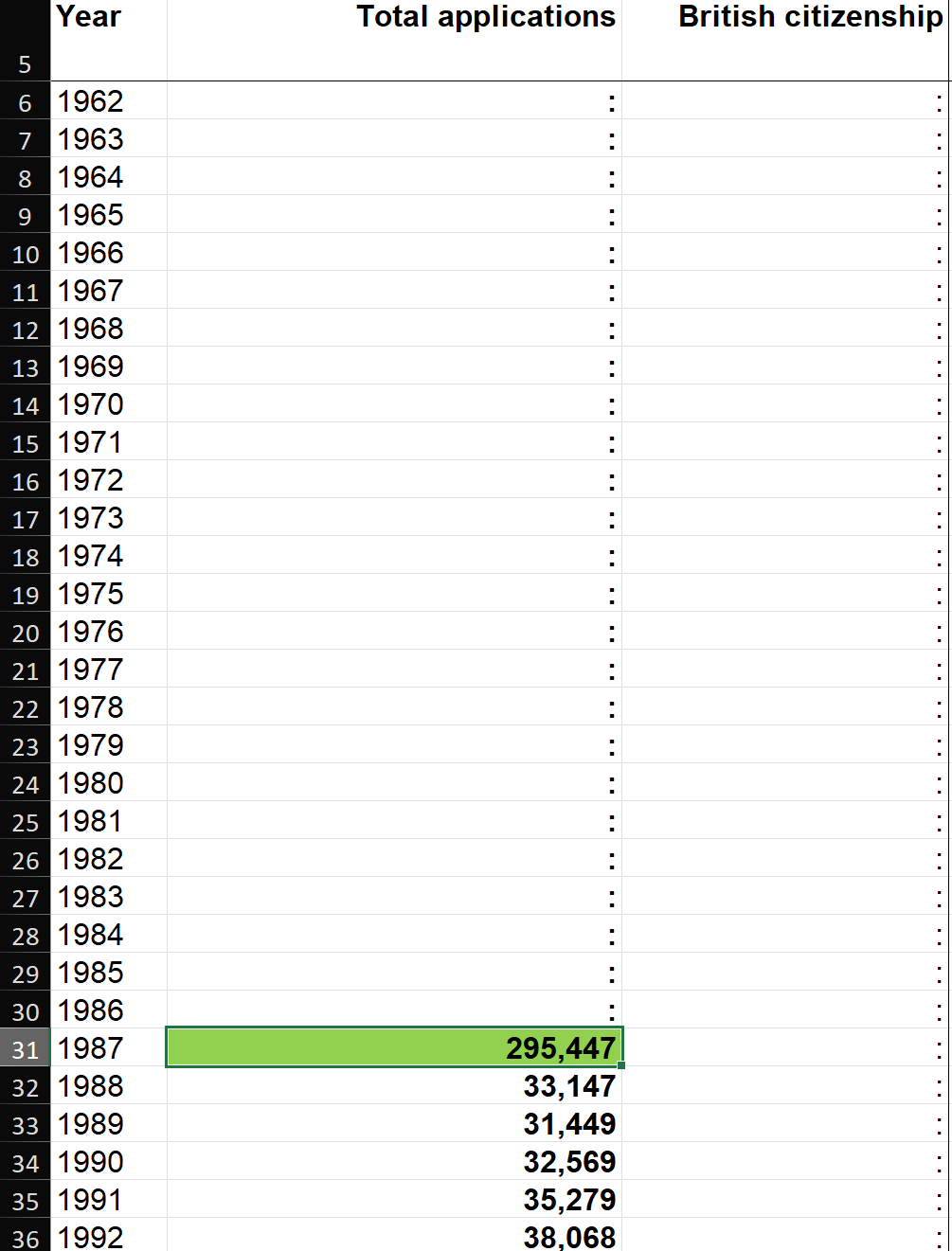
Essentially, because it looked implausible, how could we go from 295,447 applications in 1987 and then fall to 33,147 in 1988, that’s an 89% drop in just one year.
I assumed (wrongly) that the figure of 295,447 British citizenship applications in 1987 must have been a cumulative total up-to that point, or at least the total number of applications from 1962 to 1987, which is when the Home Office claim records in the form of Command Papers began.
1962 to 1987 encompasses 25 years and 295,447 spread out over a 25-year period would average around 11,818~ citizenship applications per year, which seemed a reasonable figure for the time, given levels of immigration in the 1960s, 1970s and 1980s were substantially lower than they are today.
Plus, there is also no mention in the notes section of the citizenship summary document, or Home Office immigration statistics user guide on why British citizenship applications were so high in 1987. Even researchers from Oxford’s Migration Observatory have made the same mistake as I did and claimed citizenship applications were highest in 2025. See this post from May 2026 titled: “Expert Comment: Net migration, asylum hotels and citizenship - what to look for on UK Migration Statistics day”

This is particularly annoying as if you download an older citizenship table, such as the Q1 2012 dataset from the immigration statistics, January to March 2012 release, there is a note that explains why applications were so high in 1987:
The large number of citizenship applications received in 1987 are due to a surge before the transitional registration provisions in the British Nationality Act 1981 expired at the end of that year.
Such a note is absent in the newer Home Office releases. If you are reading this in several weeks, months or years, it’s possible they might have added this note back in or mention the spike in the user guide. This is part of a recuring trend where newer Home Office releases often have less information than older releases in the same series and when queried, the Home Office migration statistics team will cite some vague “user feedback” or say the releases were condensed to improve readability, even though the purpose of these statistics is to be as detailed as possible.
Transitional arrangements in the British Nationality Act 1981, which among many things, ended birthright citizenship, came to an end on 31 December 1987. This led to an explosion in the number of people applying for British citizenship to beat the deadline.
Here’s a clip from the BBC Archives, which mentions in the weak leading up-to the deadline, over 8,000 applications were received.
The following excerpt is also provided on the Parliament website:
Before the transitional provisions of the British Nationality Act 1981 came to an end on 31 December 1987, applications for British citizenship were running at the level of 60-65,000 applications a year. However, in 1987 the Home Office received nearly 300,000 applications for British citizenship and it is considered that, were it not for the ending of certain entitlements to registration, many of the applications received in 1987 would have been made in slower time in subsequent years.
The Home Office doesn’t appear to have any data on British citizenship applications prior to 1987, at least records that are publicly available.
After some enquiries with the House of Commons Enquiry Service (who I must say are very helpful), they were able to track down a debate in the House of Lords on 3 March 1988, where some information is provided on the number of completed naturalisation and registration applications from 1979 onwards.
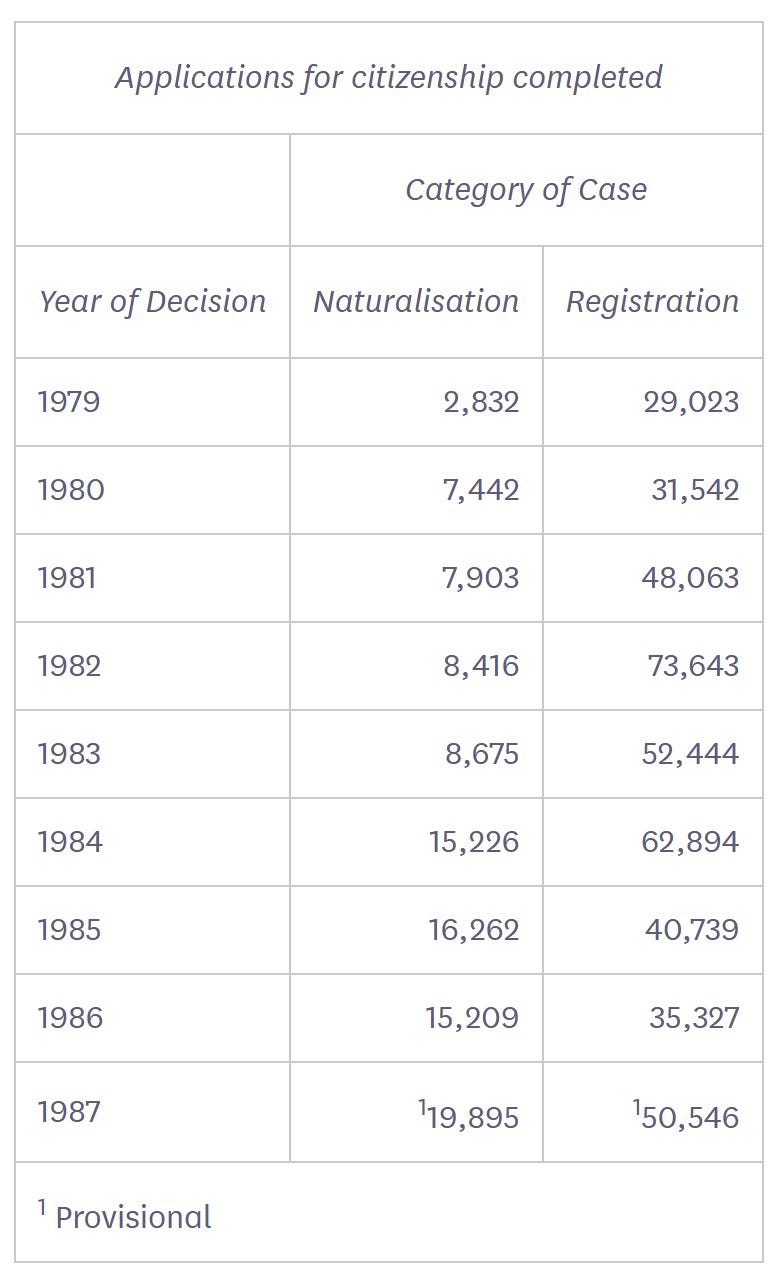
Combining the completed naturalisation and registration applications together, we can roughly gauge the following British citizenship applications by year:
1979: 31,855
1980: 38,984
1981: 55,966
1982: 82,059
1983: 61,119
1984: 78,120
1985: 57,001
1986: 50,536
1987: 295,447 (taken from Home Office release, rather than provisional figure above)
A debate on British nationality took place in the House of Commons on 11 April 1984 and there are some references to registration applications made in previous years:
Indeed, the Home Office estimated that there would be only 15,000 applications for registration in 1982–83. It was miles out when it made that estimate. There has never been such a low figure as 15,000 in any one of the previous 10 years; in fact, in 1981 there were not 15,000 but 40,000 applications.
The Home Office estimated that registrations would run at two and a half times the number of naturalisations, and on that basis—even on its own figures—it should have been expecting 35,000 applications. In fact, there were 70,000 applications, not 35,000.
In 1977, the nationality division processed about 24,000 applications. In 1981–82 it processed 50,449, in 1982–83 79,418, in 1983–84 67,332 and in 1984–85 66,000.
The following excerpt is also available from a debate in the House of Commons on 5 November 1987 concerning nationality and includes registration applications for 1985 (33,756) and 1986 (37,873).
I think both of these debates are less useful as they only seem to concern registration applications, not naturalisation and the House of Lords debate took place at a later date, so the figures referenced are more likely to be up to date.
If you add in the 1979 to 1986 application numbers, the end result would look like this.
This might not be a bullet-proof method, but absent of any other data, I think this quite a good picture of British citizenship applications up-to 1987.
If the Home Office has data going back further or figures which differ from the above, they should release them.
If you’ve enjoyed this post, please consider subscribing to the Substack to be notified when new ones are released and share this one.